The LLM integration paradox Part II: Paying Technical Debt

While I wanted to write next about how societal structures usually are dragged behind in the wake of disruptive technologies, a comment to my previous blog brought the issue of technological debt to my attention. Technological debt accrues from trouble-shooting rather than future-proofing a problem, and it needs to be repaid afterwards to avoid stalling operations. The ability to redeem technological debt depends on how a developer has anticipated technological progress and its implications.

The very nature of disruptive technologies, such as generative AI, make predicting their implications like gazing in a fortunetellers crystal ball.
I would never arrogate to make that prediction, but here I am bowing again to one of my favorite thinkers: “Do not seek to foresee the future, but to enable it to happen” (Saint-Exupery, Citadelle 1948, published posthum). In the world of fast moving tech, we must allow new ideas to resonate and build upon good ideas of the past. This is how RUDS started its life roughly 13 years ago, when we needed a hyper agile framework that enabled us to integrated new information technology on demand without disturbing a smoothly running system. While at its core RUDS always had been a symbolic AI – tech from before the AI winter –, its framework enabled it to easily connect software and data running at lower or higher abstraction levels using its semantic engine.
A core requirement for RUDS was to have a running system at all times, no matter what kind of technology we would add to it.
This is why RUDS can integrate modern AI into existing workflows without disrupting legacy systems and accept at the same time yet to come technology from the future. With this approach, we reduce the friction for AI integration and adoption, and we negate the pile-up of technological dept.
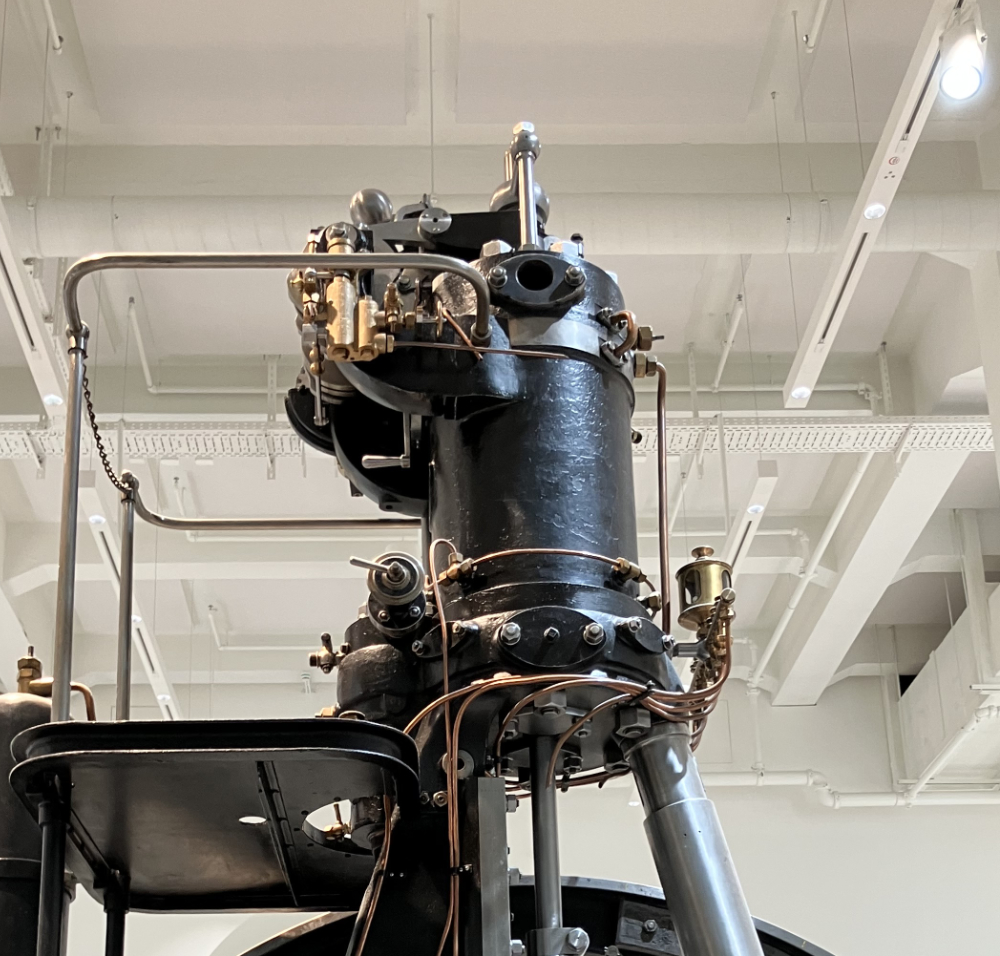
If you have read my previous blog entry talking about Diesel’s stationary engine coming into a world of coal and steam, I also think that technological debt of potential Diesel engine adopter’s contributed to Rudolf Diesel’s lack of immediate success and possibly to his demise as an entrepreneur. While a Diesel engine had a far greater efficiency and ease of use than comparable steam engines, replacing coal and steam with new infrastructure and operations was costly and not readily adoptable. We see a similar situation with today’s AI adoption, where software, which was originally designed for people, suddenly must integrate AI with complex and rigid APIs, only to find out that the human is now left out of the resultant opaque structure. In the end, the software must be changed again to better accommodate people in the workflow. With the accelerating AI development cycle, this means that technological debt is accruing faster than it can be paid back – steadily growing like “The Nothing” in Michael Ende’s The Neverending Story and ready to devour, or in our case, prevent a successful adoption of AI.
This brings me to an important point: not all AI integration approaches are created equal, and some are building up more technological debt than others.
A common method for improving AI relevance today is Retrieval-Augmented Generation (RAG). RAG works by retrieving information from a vector database and feeding it into an LLM to improve factual accuracy. On paper, this sounds great—more context, better answers.
But there’s a catch—a Catch-22 kind of catch (Ok, I am stretching it a little bit here, but it is another favorite of mine).
RAG-based systems are essentially patchwork solutions. They retrieve information based on similarity, not understanding. RAG pulls data based on vector proximity, which means it might retrieve factually relevant information but without knowing why it’s relevant. That’s the first half of the Catch-22: RAG relies on information retrieval to improve AI relevance, but it can’t tell if the retrieved data actually fits the context.
And here’s the twist:

If the retrieved data is flawed or mismatched, the LLM will still confidently generate an output—because that’s what it’s designed to do. There’s no built-in mechanism for validation or correction. So RAG is stuck—it needs external data to improve accuracy, but it lacks the ability to judge whether that data makes sense in context. It’s like Diesel’s first engine, trying to run on steam infrastructure—it technically works, but not well enough to unlock its full potential.

This is why we created RUDS. RUDS isn’t just another AI model—it’s a new paradigm. Unlike RAG, which relies on surface-level similarity, RUDS creates a shared semantic framework where data isn’t just retrieved—it’s understood. RUDS enables AI to reason across structured and unstructured data by building a semantic layer that allows different systems to interpret and validate information based on context and intent. And while RUDS doesn’t need a vector database to operate, it can integrate one if needed—because it’s built to unify, not to patch.

But that’s not the biggest difference. RUDS also tackles the governance problem that RAG-based architectures ignore. RUDS integrates an expert system capable of applying rule-based validation to AI-generated insights. This means that AI outputs are not only more accurate—they are explainable, traceable, and operationally aligned. RUDS retains context over time, constantly updating its semantic framework so AI decisions aren’t made in isolation—they’re grounded in a dynamic, evolving understanding of the entire system.

RAG retrieves facts—RUDS understands meaning. This is why RUDS reduces technological debt rather than accumulating it. When you build AI on a semantic foundation, you’re not bolting intelligence onto outdated infrastructure—you’re laying the groundwork for AI-native ecosystems. Just as Diesel’s engine only reached its full potential when it broke free from steam infrastructure, AI will only reach its true potential when it moves beyond the brittle, API-based systems of today. That’s what RUDS enables.

If you want to know more, get in Touch.

«