
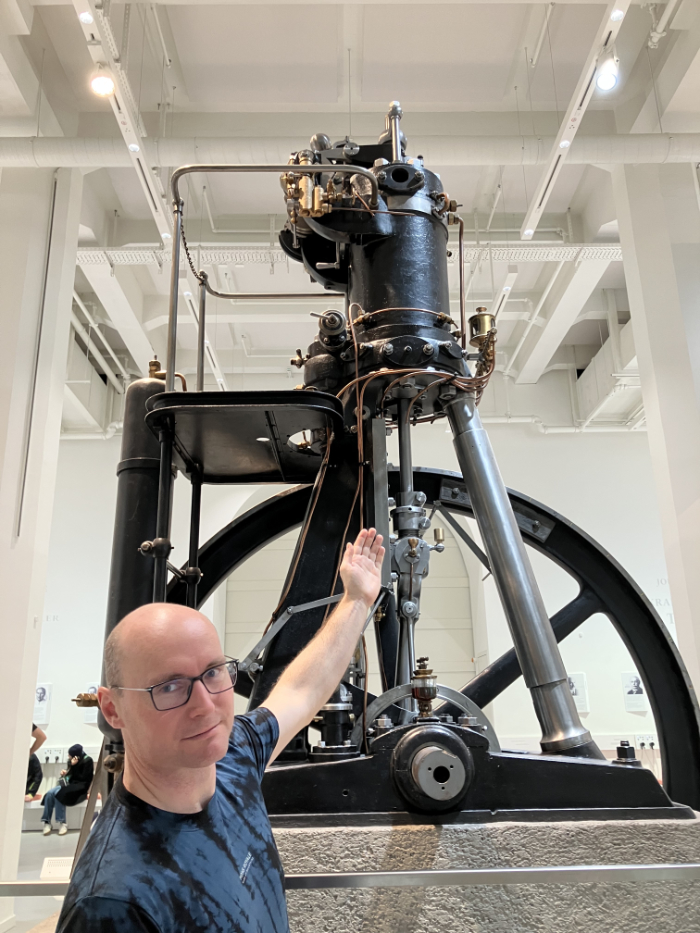
Last Monday, I was standing in front of the first fully functional Diesel engine at the German Museum in Munich. As I examined it, something struck me: Rudolf Diesel had invented an entirely new technology, but the world around him was still in the age of steam.
Diesel’s internal combustion engine was revolutionary, yet it had to be built using steam engine components. Its footprint and frame matched that of existing steam engines, and it even featured a massive flywheel, designed to accommodate a transmission belt—because that’s how factories operated at the time. Only later, when society transitioned from steam power to internal combustion and electrification, did things change. Diesel engines no longer powered stationary machines via belts; they became the driving force behind ships, trucks, generators, and countless other applications. The engines evolved, shedding their steam-era design constraints to become sleek, enabling technology that shaped an entirely new infrastructure, from highways, over truck terminals, to heavy construction machinery


AI is at the same crossroads today.
Generative AI is a breakthrough, yet we are still building and integrating it within an IT infrastructure designed for humans—one based on operating systems, networks, and API-driven applications that were never meant to support context-aware, probabilistic reasoning systems. Just as early Diesel engines were forced to fit within the steam era’s constraints, today’s LLMs are being squeezed into API-based architectures, brittle workflows, and legacy enterprise software—creating inefficient, fragile integrations that fail to unlock AI’s full potential.
This is what I call, “the LLM Integration Paradox”: AI promises transformation, yet its deployment is still dictated by an outdated digital framework that requires extensive investment to ensure trust, accuracy, and seamless integration. To fully harness AI’s power, we must move beyond these constraints—just as Diesel engines eventually shed their steam-era limitations.
We need a new paradigm!
RUDS: A New Paradigm for the AI Era
Knowing the constraints of API-driven software and current digital systems, we decided to attempt to create this new paradigm, while taking advantage of what is already here. We created what we call RUDS. (Rule-based Unification of Digital Systems using Semantics).
And I want to emphasize, RUDS is not just another AI model—it is a new paradigm.
So, Let’s have a look at the current problems, and when does RUDS breaks free:
Problems:
There are three fundamental problems with today’s approach:
- lack of generic system unification
- LLMs’ lack or poor governance, and
- LLMs’ lack of transparency.
As a result, organizations struggle to integrate LLMs into their current landscape. Organizations struggle for control over technology shaped by dominant market forces and face high costs and dependencies when integrating LLMs.
Problem 1
Lack of generic system unification:
Today’s IT systems are built in isolation, communicating through static, syntactic data exchanges such as APIs, which merely transmit information without conveying its meaning. This is why AI struggles in enterprise environments—it’s being forced to process fragmented inputs that lack context and relationships, like Diesel fitting the Diesel engine into a steam engine frame. AI, like Diesel’s invention, is being squeezed into an outdated infrastructure, limiting its full potential.
Traditional solutions either treat AI as a black box or rely on static, predefined mappings, which make true interoperability impossible. RUDS solves this by enabling AI to unify meaning dynamically allowing different systems to not just exchange data, but to reason collectively based on a shared, contextual framework.
How does RUDS solve this: Semantic Unification
The first piece of the puzzle is semantic unification; but what does semantic unification exactly mean? According to Wikipedia “It (semantics) examines what meaning is, how words get their meaning, and how the meaning of a complex expression depends on its parts.”
Semantic unification of digital systems is therefore the process of ensuring that different AI models, software applications, and data sources don’t just exchange information—but actually understand it in a shared, meaningful way. It goes beyond syntactic integration (which focuses on formats, APIs, and protocols) to ensure that data is interpreted contextually and correctly across diverse systems.
In simple terms, it’s about making digital systems speak the same language—not just at the data level, but at the meaning level.
The concept of semantic unification has been around for decades, but as far as I know, no one has solved it in a way that is scalable, AI-driven, and governance-compliant.
Problem 2
LLMs’ lack or poor governance:
Imagined what would have happened if Diesel hadn’t defined precise control mechanisms—if engines had been left to run unpredictably, without regulation (Dieselgate anyone?) or constraints. That’s exactly what’s happening with LLMs today: they generate outputs without clear boundaries, making errors that cannot be traced, explained, or corrected.
The loyalty of publicly accessible, proprietary LLMs is at best questionable—and at worst, these systems could be playing their own game, misaligned with users’ needs. As long as AI remains under the sole control of its creators, enterprises integrating these models risk becoming dependent on black-box intelligence they cannot fully govern or trust.
How does RUDS solve this: embedded an expert system AI
The second piece of the puzzle is making AI accountable and aligned. To do this, AI must operate within human-built rules—rules that ensure:
- Freedom from errors (eliminating hallucinations and inconsistencies)
- Fidelity and alignment (ensuring AI serves the user, not external interests)
- A safeguard against harm (preventing biased or damaging outputs)
To fix this problem, we embedded an expert system AI that applies recursive first-order logic to validate AI reasoning, check premises, and derive valid inferences. With RUDS, AI governance is built-in—not an afterthought. It integrates new data sources, applies expert-driven rules, and ensures AI outputs are not just probabilistic guesses but structured, validated decisions.
Without this layer of governance, AI will continue making unpredictable errors, operating in a regulatory gray zone where decisions cannot be fully understood, controlled, or aligned with business goals.
Because, digital systems are semantically unified, our embedded expert system AI can dynamically “learn” by using the LLM to update its ontology.
Problem 3
LLMs’ lack of Transparency
Last piece of the puzzle, address system transparency.
LLMs today function like black boxes, generating responses without clear reasoning, traceability, or validation. They are powerful, but they are also opaque and unpredictable, making them unreliable for critical decisions.
The whole LLM lack of transparency reminds me to the Saint-Exupéry’s Night Flight—a painfully beautiful novel about early aviation: The pilot Fabien flies in stormy darkness, unable to see his surroundings, relying only on inadequate instruments and his intuition, to finally perish in the cyclone. That’s exactly what enterprises are doing today with AI—they’re flying blind, integrating AI without knowing if, how, and why its rules are enforced, while being at the mercy of big tech.
How does RUDS solves this: RUDS ensures AI outputs are fully explainable, traceable, and auditable
For AI to be trustworthy, it must offer complete transparency into its internal logic and its interactions with connected systems.
RUDS enables this by ensuring AI outputs are fully explainable, traceable, and auditable—removing the uncertainty that makes today’s AI solutions unfit for mission-critical applications..
RUDS finally closes the gaps in:
- Theoretical semantic frameworks (which lacked dynamic adaptability)
- LLMs & probabilistic AI (which lacked transparency & validation)
- Enterprise integration solutions (rigid API-driven digital systems)
This is why RUDS is a paradigm shift—not because it reinvents the ideas of semantic unification or expert system AI, but because it makes these ideas work at scale for real-world AI-driven systems. Borrowing from another favorite of mine, RUDS is like the program Tron in its cinematic grid, and like Tron, “RUDS fights for the user!”
If you want to know more, get in Touch.